
ECU Part Number, Machine PIN and Engine Serial Number Explained
August 15, 2026 · XAVORNIK Editorial Team
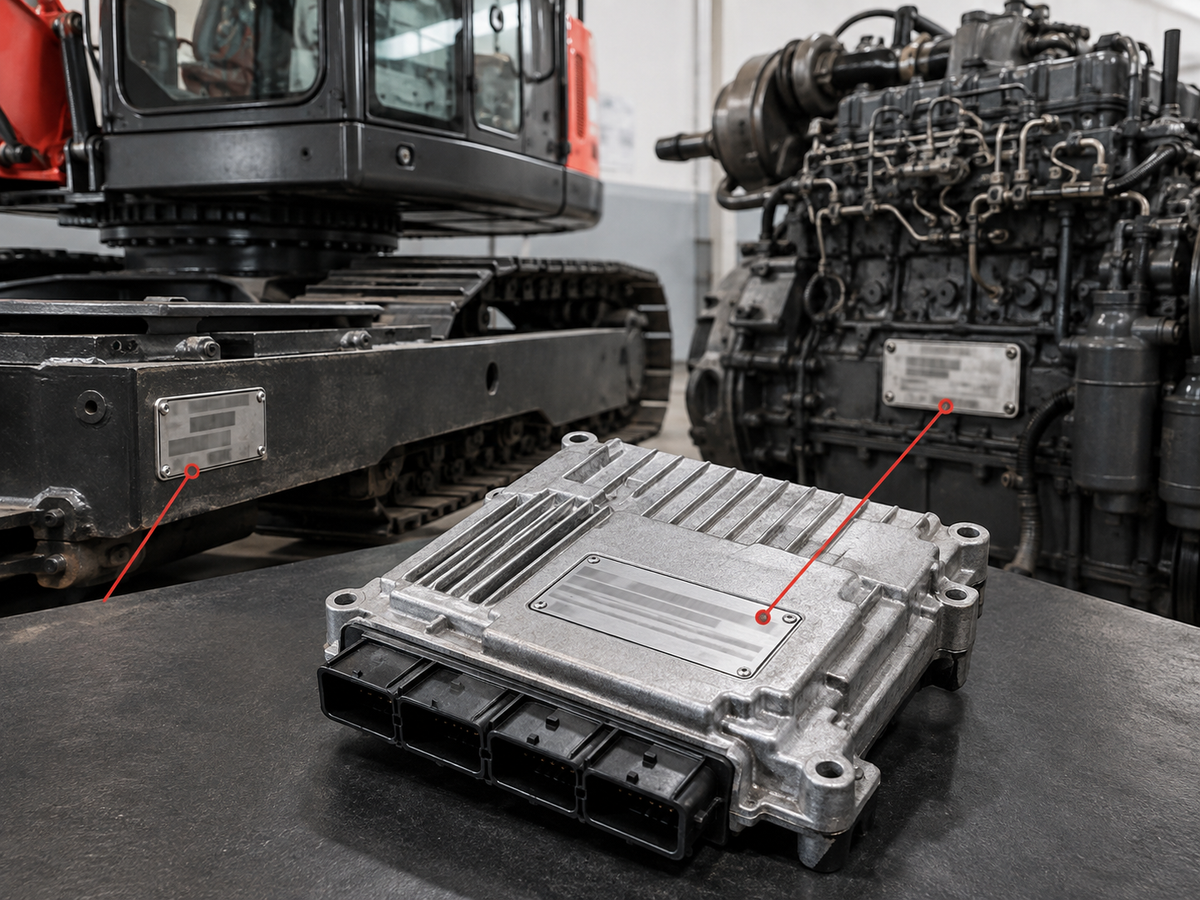
When ordering an ECU, ECM or other electronic control module for construction equipment, customers are often asked to provide three different pieces of information: the ECU or ECM part number, the machine PIN or serial number, and the engine serial number.
These identifiers are related, but they do not identify the same thing. Understanding the difference is especially important when replacing a programmed electronic control module. Two machines with the same model designation may use different control modules, software configurations or engine specifications depending on production date, serial-number range and machine configuration.
This guide explains what each number means, where to find it and why it matters before ordering a replacement ECU.
1. What Is an ECU or ECM Part Number?
The ECU part number identifies the electronic control module itself.
Depending on the manufacturer and application, the unit may be described as an ECU, ECM, Engine ECM, Machine ECM, Vehicle Control Module, Controller or Electronic Control Module. Terminology varies, but the basic principle is the same: the part number refers to the physical electronic module or a specific service replacement for it.
Manufacturers may assign different part numbers to control modules that look almost identical externally. The difference may involve hardware configuration, connector arrangement, internal electronics, software compatibility or the machine systems the module is designed to control.
Some manufacturers also use programmable electronic control modules whose function depends partly on the software or calibration installed. This is one reason why matching appearance alone is not a reliable method of selecting a replacement ECU.
Where to find the ECU part number
The safest place to start is the identification label on the original ECU. Record every readable number and photograph the complete label clearly before removing the unit.
Look for information such as:
- Part number, P/N or Part No.
- Hardware number
- Software or calibration information
- Manufacturer reference number
- Module serial number
- Replacement or remanufactured reference numbers
Do not rely only on a number found in an online listing or on a control module that simply looks similar to the original.
2. What Is a Machine PIN?
PIN usually means Product Identification Number. It identifies the machine rather than the ECU or engine.
Depending on the equipment manufacturer, the same type of identifier may also be called a Machine Serial Number, Equipment Serial Number, Product Serial Number or, on some equipment, a VIN.
The machine PIN is normally found on the equipment identification plate or frame identification plate. It can help determine the exact machine configuration, model variant and production range.
Why the machine model alone may not be enough
An excavator, loader, bulldozer or other machine model can remain in production for several years. During that period, the manufacturer may change engines, wiring harnesses, controllers, sensors, communication systems, emissions equipment, monitors or software.
As a result, two machines carrying the same model designation may not necessarily use the same ECU.
The machine PIN therefore helps answer an important question: Which exact machine configuration does this control module need to work with?
3. What Is an Engine Serial Number?
The Engine Serial Number, often abbreviated as ESN, identifies the engine itself. It is different from the machine PIN.
A construction machine contains many major assemblies, and the engine has its own identification system. The same machine family may use different engine versions, while the same engine family may also appear in several types of equipment.
The engine serial number can help identify the exact engine configuration and may be important when verifying engine ECMs, calibration requirements and other engine-specific electronic components.
The ESN is normally found on the engine identification plate or data plate. Depending on the engine manufacturer, the plate may also show:
- Engine model
- Displacement
- Arrangement or specification number
- CPL or configuration code
- Rated power
- Emissions information
- Manufacturing data
The key point is simple: the machine PIN identifies the machine, while the engine serial number identifies the engine.
4. Why Does an ECU Seller Ask for All Three Numbers?
Because each identifier answers a different fitment question.
ECU Part Number
Answers: What electronic control module is currently installed?
This is usually the strongest starting point for identifying a replacement ECU.
Machine PIN
Answers: Which exact machine configuration does the ECU need to operate in?
It helps verify machine application and production range.
Engine Serial Number
Answers: Which exact engine configuration is installed in the machine?
This becomes especially important for engine ECMs and programmed control modules.
Used together, these three references provide much stronger identification than any one number alone.
5. Is the ECU Part Number Alone Enough?
Sometimes, but not always.
If the original part number is clearly readable and the replacement is an exact, verified service replacement, the part number may be enough to identify the hardware. However, additional machine and engine information is still recommended for programmable ECUs and ECMs.
Part numbers may be superseded
Manufacturers sometimes replace an older control-module part number with a newer service number. The newer number may be an approved replacement, but the supersession relationship should be verified rather than assumed.
The same hardware may support different applications
Some electronic control modules can be programmed for different machine or engine applications. Correct hardware therefore does not always mean the unit is ready for a specific machine.
The machine may have been modified
An engine, wiring harness or controller may have been replaced during the machine's service life. The current configuration may therefore differ from the original factory configuration.
For this reason, a professional fitment check should compare the ECU part number with the machine and engine information whenever possible.
6. Why Is ECU Programming Important?
An ECU is not simply an electronic box. Modern control modules use software, calibration data and machine-specific parameters to interpret sensor inputs and control engine or machine functions.
Depending on the application, replacement may involve:
- Application software
- Engine calibration
- Machine configuration
- Parameter settings
- Injector-related information
- Machine identification data
- Commissioning after installation
The exact programming procedure varies by manufacturer, machine and ECU type.
Therefore, never assume that every ECU with the correct housing and connectors is automatically plug-and-play.
7. Can Two ECUs With the Same Shape Be Different?
Yes. External appearance is only a secondary reference.
Two ECUs may have very similar aluminum housings, mounting holes, connector sockets and overall dimensions, but still differ in:
- Part number
- Internal hardware
- Firmware
- Application software
- Pin assignments
- Machine application
- Programming requirements
The original ECU label should always take priority over appearance.
8. What If the Original ECU Part Number Is Missing?
If the original label is damaged, missing or unreadable, do not select a replacement from one photograph alone.
Provide as much information as possible:
- Machine manufacturer
- Complete machine model
- Machine PIN or serial number
- Engine manufacturer and model
- Engine serial number
- Front and rear photos of the ECU
- Close-up photos of every connector
- ECU mounting location
- Any readable numbers on the housing
- Photos of the machine and engine identification plates
This information can help narrow the possible control module, but final verification may still be required before ordering.
9. Machine PIN vs Engine Serial Number: A Simple Example
Imagine an excavator with the following information:
- Machine model: Excavator Model A
- Machine PIN: Machine identification number 123456
- Engine: Diesel Engine Model B
- Engine Serial Number: Engine identification number 987654
- Installed ECU Part Number: ECU 111-2222
Each number describes a different object.
The machine PIN identifies the complete excavator. The engine serial number identifies the engine installed in that excavator. The ECU part number identifies the electronic control module fitted to the machine or engine.
This is why a request such as “I need an ECU for Excavator Model A” may not provide enough information for a reliable fitment decision.
10. What Information Should You Send Before Ordering an ECU?
For a professional fitment check, prepare the following information whenever possible:
- Original ECU part number
- Machine make
- Complete machine model
- Machine PIN or serial number
- Engine model
- Engine serial number
- Clear photo of the ECU label
Also helpful:
- ECU front and rear photos
- Connector photos
- Machine nameplate photo
- Engine nameplate photo
- Information about previous ECU replacement
- Information about previous engine replacement
- Existing fault codes or reason for replacement
The more complete the information, the lower the risk of ordering an incorrect or incorrectly programmed module.
11. Before Installing a Replacement ECU
Correct part identification is only one part of ECU replacement.
Before connecting a replacement control module, inspect the machine for possible causes of the original ECU failure. Check:
- Battery and charging voltage
- Power supply
- Ground connections
- Connector condition
- Bent or corroded terminals
- Wiring shorts
- Water ingress
- Damaged sensors or actuators
- Previous wiring modifications
A wiring or power-supply fault that damaged the original controller can also damage a replacement ECU.
Programming and electrical diagnosis should be carried out by qualified personnel using appropriate service information and diagnostic equipment.
12. Pre-Order ECU Identification Checklist
- The original ECU part number has been recorded.
- The machine PIN or serial number has been recorded.
- The engine model has been confirmed.
- The engine serial number has been recorded.
- The ECU connectors have been compared with the original unit.
- Any replacement or superseded part number has been verified.
- Programming requirements have been confirmed.
- The seller has been informed if the engine or ECU was previously replaced.
- The machine electrical system has been checked if ECU failure is suspected.
What Information Should You Send XAVORNIK?
If you need help identifying a replacement ECU, send XAVORNIK:
- Original ECU part number
- Machine make and complete model
- Machine PIN or serial number
- Engine model
- Engine serial number
- ECU label photo
- Connector photos
- Machine and engine nameplate photos
For programmed ECU products, additional machine information may be required before shipment.
Providing complete identification information before ordering is much safer than selecting an ECU from appearance or machine model alone.
Final Takeaway
The ECU part number, machine PIN and engine serial number are three different identifiers:
- ECU Part Number: identifies the control module.
- Machine PIN: identifies the machine.
- Engine Serial Number: identifies the engine.
For a replacement electronic control module, especially a programmed ECU, the best practice is to verify all three whenever possible. This helps reduce incorrect orders, software mismatches and installation problems before the replacement ECU reaches the machine.