
Does a Replacement Excavator ECU Need Programming?
August 15, 2026 · XAVORNIK Editorial Team
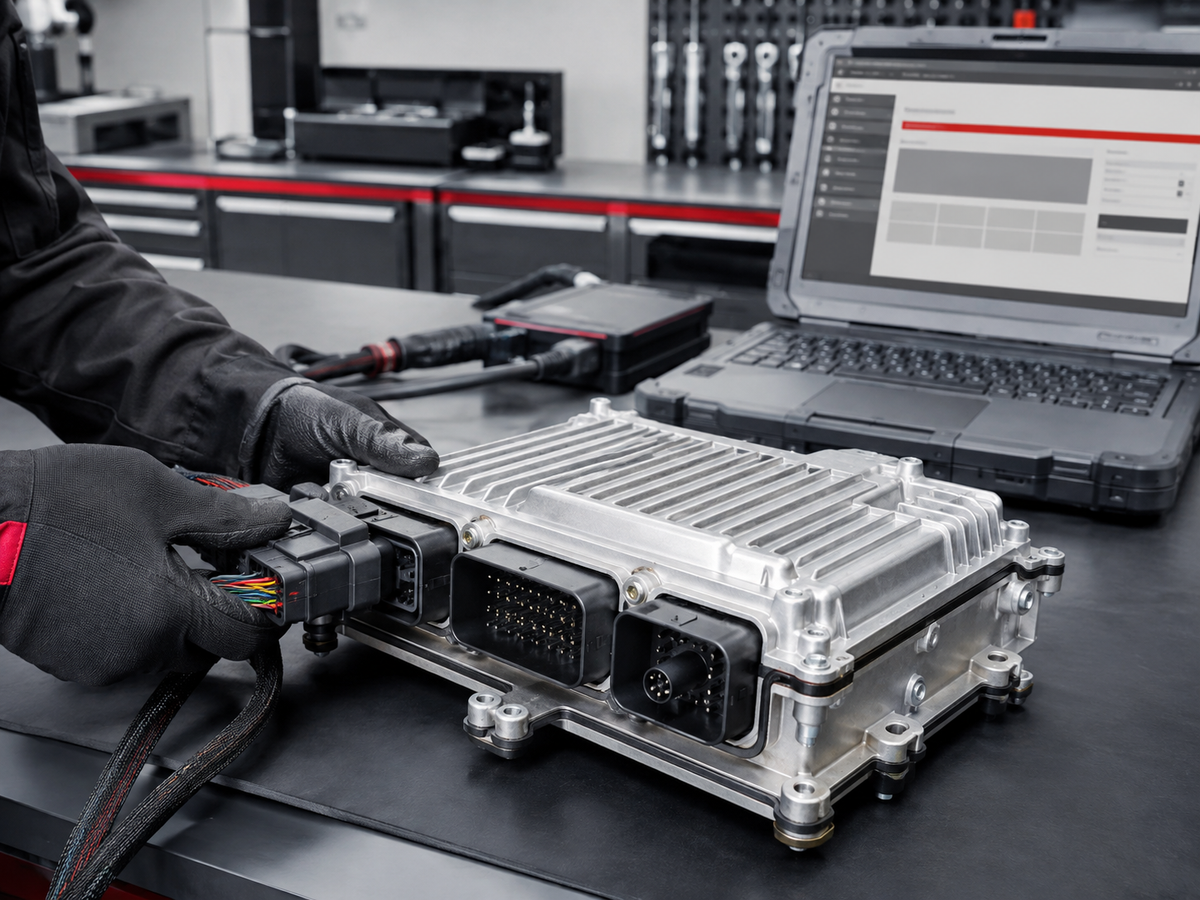
Replacing an excavator ECU or ECM is not always as simple as matching the part number, connecting the plugs and starting the machine.
Some replacement electronic control modules are supplied with the required software or configuration already installed. Others are programmable modules that must be configured for a specific machine, engine or application before they can operate correctly.
That is why one of the most important questions to ask before ordering is: Does this replacement ECU need programming?
The answer depends on the ECU type, manufacturer, machine configuration and how the replacement unit is supplied.
This guide explains the difference between ECU hardware and programming, what information may be required before programming, and what should be checked before installing a replacement control module.
1. What Does “ECU Programming” Mean?
An ECU, ECM or electronic control module contains physical electronic hardware, but its operation also depends on software and configuration data.
The hardware receives information from sensors and other control units, processes that information and sends commands to different machine or engine systems.
Depending on the application, software or configuration inside the ECU may determine functions such as:
- engine control;
- fuel delivery;
- hydraulic operation;
- machine communication;
- transmission control;
- emissions functions;
- warning strategies;
- operating parameters; and
- interaction with other electronic control modules.
This means that two ECUs can have similar housings and connectors but behave differently if they contain different software or configuration.
Some manufacturers specifically describe replacement control modules as programmable electronic control modules, while other modules may be supplied with specified software already included.
2. Does Every Replacement ECU Need Programming?
No. There is no universal rule that every replacement excavator ECU must be programmed.
A replacement ECU may fall into several different categories.
ECU supplied with the correct software
Some replacement modules are supplied with application software already installed.
If the hardware, software and machine application have all been correctly verified, additional programming may be limited or may not be required before installation.
However, machine-specific initialization, parameter setting or commissioning may still be necessary depending on the equipment.
Programmable replacement ECU
Some control modules are specifically designed to be programmed for the intended application.
In these cases, installing the physical ECU without the required software or configuration may not produce a functional replacement.
Pre-programmed aftermarket ECU
Some aftermarket suppliers program the replacement ECU before shipment using information supplied by the customer.
The buyer may therefore receive a module that has already been configured for a particular machine or engine application.
Even in this situation, the customer should confirm exactly what has been programmed and whether any on-machine setup is still required.
Used or remanufactured ECU
A used or remanufactured ECU may still contain software or parameters from the previous machine.
It should never be assumed that a used module is automatically ready for another machine simply because the part number matches.
Programming, clearing previous configuration or additional setup may be required.
3. Why Can the Correct Part Number Still Require Programming?
The ECU part number identifies the control-module hardware or a particular service replacement, but it does not always describe every software setting stored inside the unit.
Some control modules can support multiple machine or engine applications.
That means: correct hardware does not necessarily mean correct software configuration.
A module may need software, calibration or machine-specific parameters before it can communicate correctly with the rest of the equipment.
This is why part-number verification and programming verification should be treated as two separate checks.
4. What Information May Be Needed Before Programming an ECU?
Requirements vary by manufacturer and ECU type, but the supplier or technician may ask for several pieces of machine information.
Common information includes:
- original ECU part number;
- machine make;
- complete machine model;
- machine PIN or serial number;
- engine model;
- engine serial number;
- photos of the original ECU label;
- hardware number;
- software or calibration number;
- machine configuration information; and
- information about previous ECU or engine replacement.
For some applications, additional data may be required.
This is why customers should not provide only a machine model such as “I need an ECU for a Volvo excavator.” That description is usually too broad for a professional programming decision.
5. What Is the Difference Between Part Number Matching and Programming?
These are two separate checks.
Part-number matching
Part-number verification asks: Is this the correct ECU hardware or verified replacement hardware?
This involves checking:
- original part number;
- replacement or superseded part number;
- connector arrangement;
- housing;
- mounting points;
- electrical specification; and
- application information.
Programming verification
Programming asks: Does this ECU contain the correct software and configuration for this particular machine?
A successful replacement may require both.
Matching only one side of the equation can still result in a non-working ECU.
6. What Happens If an ECU Is Not Programmed Correctly?
The result depends on the machine and control module.
Possible symptoms can include:
- engine does not start;
- ECU does not communicate with the machine;
- diagnostic tool cannot identify the controller correctly;
- warning messages or fault codes appear;
- engine performance is incorrect;
- hydraulic or machine functions do not respond correctly;
- some functions remain disabled; or
- communication faults appear between electronic control units.
However, these symptoms do not automatically prove that programming is the problem.
Similar symptoms can also result from:
- incorrect part number;
- damaged wiring;
- poor grounds;
- low or unstable battery voltage;
- connector problems;
- CAN communication faults;
- damaged sensors;
- another failed control module; or
- incorrect installation.
Proper diagnosis is therefore important before replacing or reprogramming an ECU.
7. Does “Pre-Programmed” Mean Plug-and-Play?
Not necessarily.
The phrase pre-programmed ECU generally means that some required software or configuration has already been written to the module before shipment.
It does not automatically guarantee that no additional work will ever be required after installation.
Depending on the equipment, the technician may still need to perform:
- machine recognition;
- calibration;
- parameter verification;
- diagnostic checks;
- fault-code clearing;
- component synchronization;
- commissioning procedures; or
- software verification.
For this reason, “pre-programmed” and “plug-and-play” should not be treated as identical terms unless the specific product and application have been verified.
A safer description is: Programmed based on the machine information provided before shipment. Additional on-machine setup may be required depending on the application.
8. Why Are Machine PIN and Engine Serial Number Important for Programming?
The ECU part number, machine PIN and engine serial number identify different things.
- ECU Part Number: identifies the control module.
- Machine PIN: identifies the machine.
- Engine Serial Number: identifies the engine.
Programming may depend on information from all three.
Two excavators with the same commercial model designation may have different engines or electronic configurations because they were produced at different times or for different markets.
Likewise, an engine may have been replaced during the machine's working life.
Collecting all three identifiers gives the supplier or technician a stronger basis for determining the required ECU configuration.
9. Should You Copy the Software From the Old ECU?
In some repair situations, technicians may be able to retrieve configuration or software-related information from the original ECU.
However, whether this is appropriate depends on:
- the ECU design;
- the condition of the original ECU;
- manufacturer procedures;
- available diagnostic equipment;
- authorization and software access; and
- the type of failure.
If the original module has suffered severe electrical, water or internal memory damage, useful information may not always be recoverable.
Programming should therefore follow the correct service procedure for the specific machine rather than relying on a generic copying method.
10. Can You Program an Excavator ECU Yourself?
For most professional construction-equipment applications, ECU programming should be handled by a qualified technician or supplier with appropriate diagnostic tools and service information.
Incorrect programming can create additional faults or leave the machine unable to communicate with the replacement controller.
If you are purchasing a programmed replacement ECU, ask the supplier exactly what information is needed before shipment and whether any local diagnostic procedure will still be required after installation.
11. Check the Machine Before Installing a New ECU
A failed ECU is sometimes the result of another electrical problem.
If the cause of the original ECU failure is not corrected, the replacement module can also be damaged.
Before installing a new ECU, inspect:
- battery voltage;
- charging-system voltage;
- power supply;
- ground circuits;
- fuses and relays;
- harness condition;
- connector corrosion;
- bent or recessed terminals;
- water ingress;
- short circuits;
- damaged sensors or actuators; and
- previous wiring modifications.
Do not install an expensive replacement ECU into a machine with an unresolved electrical fault.
12. Questions to Ask Before Ordering a Replacement ECU
Is this ECU programmed or unprogrammed?
Do not assume. Confirm the software status before purchase.
What information do you need from me?
Prepare the ECU part number, machine information and engine information.
Is the programming specific to my machine?
Confirm what data will be used.
Will additional setup be required after installation?
This is especially important if you do not have access to manufacturer diagnostic equipment.
Is this an exact part number or a replacement number?
If the number differs from the original, confirm the replacement relationship.
What should I check before installation?
Ask about electrical-system inspection and connector condition.
13. Information to Send XAVORNIK for a Programmed ECU
For XAVORNIK programmed ECU products, customers should provide as much of the following information as possible:
- original ECU part number;
- clear ECU label photo;
- machine make;
- complete machine model;
- machine PIN or serial number;
- engine model;
- engine serial number;
- machine nameplate photo;
- engine nameplate photo; and
- information about any previous ECU or engine replacement.
For some products, additional information may be requested before programming.
Programming should only begin after the identification information has been checked against the product being ordered.
14. Pre-Order ECU Programming Checklist
- Original ECU part number recorded
- Machine model confirmed
- Machine PIN or serial number recorded
- Engine model confirmed
- Engine serial number recorded
- ECU label photographed clearly
- Replacement part-number relationship verified
- Seller confirmed whether ECU is programmed or unprogrammed
- Required programming information submitted
- Post-installation setup requirements confirmed
- Machine power supply and wiring inspected
- Cause of original ECU failure investigated
Final Takeaway
So, does a replacement excavator ECU need programming?
Sometimes yes, sometimes no.
The correct answer depends on the specific ECU, how the replacement module is supplied and the configuration of the machine.
The most important point is that: correct part number does not always mean the ECU is ready to install.
Before ordering, confirm hardware compatibility, software status, machine information and engine information.
If the replacement ECU is supplied pre-programmed, confirm exactly what has been programmed and whether additional on-machine setup is required.
Taking these steps before purchase can significantly reduce incorrect orders, installation delays and software-related problems.